
De Propellor | The Wellington Klarenbeek
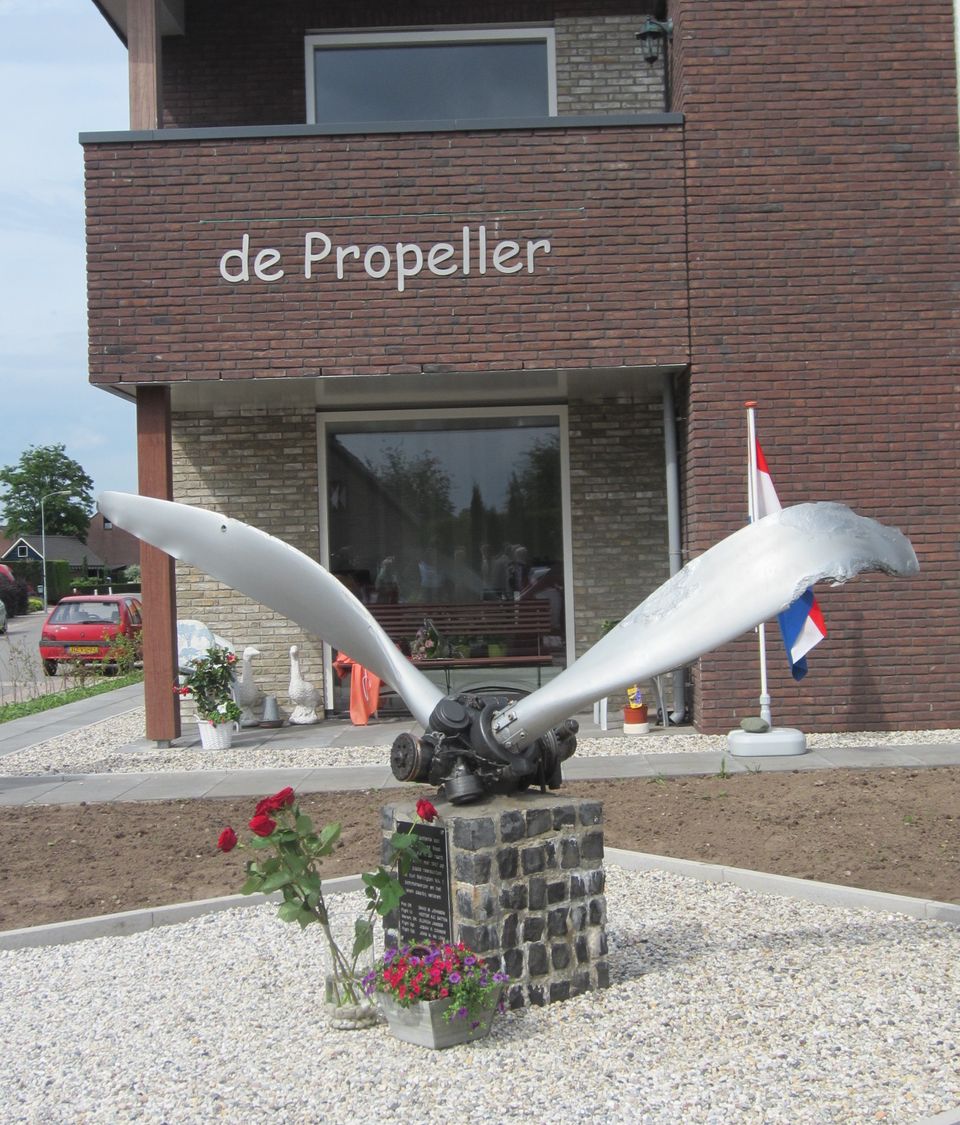
The Wellington Monument in Klarenbeek commemorates the five Allied airmen who died when their Wellington Mk. I bomber crashed at this location during the night of 30–31 May 1942.
The Wellington Monument in Klarenbeek (municipality of Apeldoorn) consists of engine parts with two damaged propeller blades, placed on a brick plinth with a commemorative plaque. The whole structure stands in a bed of gravel.
The plaque reads:
“In memory of
the five airmen of the
Royal Air Force who,
on the night of 30–31 May 1942,
crashed at this location
with their Wellington Mk. I
bomber and lost their lives.
*Pilot Off. David M. Johnson
Flight Lt. Hector A.C. Batten
Warrant Off. Oldrich Jambor
Flight Sgt. Josiah R. Connor
Flight Sgt. John M. McLean.”
The history:
The Wellington Monument in Klarenbeek commemorates the five Allied airmen who died when their Wellington Mk. I bomber crashed at this location during the night of 30–31 May 1942.
The victims were:
Hector A.C. Batten, Josiah R. Connor, Oldrich Jambor, David M. Johnson, and John M. McLean.…
The Wellington Monument in Klarenbeek (municipality of Apeldoorn) consists of engine parts with two damaged propeller blades, placed on a brick plinth with a commemorative plaque. The whole structure stands in a bed of gravel.
The plaque reads:
“In memory of
the five airmen of the
Royal Air Force who,
on the night of 30–31 May 1942,
crashed at this location
with their Wellington Mk. I
bomber and lost their lives.
*Pilot Off. David M. Johnson
Flight Lt. Hector A.C. Batten
Warrant Off. Oldrich Jambor
Flight Sgt. Josiah R. Connor
Flight Sgt. John M. McLean.”
The history:
The Wellington Monument in Klarenbeek commemorates the five Allied airmen who died when their Wellington Mk. I bomber crashed at this location during the night of 30–31 May 1942.
The victims were:
Hector A.C. Batten, Josiah R. Connor, Oldrich Jambor, David M. Johnson, and John M. McLean.
During that night, the Allies launched a major raid on Cologne involving 1,047 aircraft. The destruction was enormous. Of the 44 bombers that failed to return to England, 19 crashed in the Netherlands. One of these was the Wellington Mk. I flown by Pilot Officer David Johnson, which crashed in a meadow near the Hessen Allee in Klarenbeek.
Johnson’s Wellington took off from RAF Feltwell at 23:06 on Saturday 30 May 1942. The second pilot was Oldrich Jambor, a Czech airman who had escaped to England and joined the RAF. Sergeant Josiah Connor served as wireless operator; Lieutenant Hector A. Batten was the navigator and bomb aimer. The nose turret guns were manned by Sergeant John McLean, and the tail gunner was Sergeant Waddington-Allright.
After successfully completing their mission, Johnson’s aircraft began the return flight on a course opposite to their assigned heading—flying north instead of south. This may have been caused by a compass malfunction or misreading. After some time on this incorrect northern route, the Wellington ended up over Gelderland, where the airspace was relatively quiet.
First Lieutenant Helmut Woltersdorf, flying a German Messerschmitt 110 night fighter from Twente air base, was directed toward the Wellington. Woltersdorf attacked, firing four onboard cannons. According to eyewitnesses, bullets struck the port engine and the fuel tanks. The burning aircraft descended and crashed along the Hessen Allee, only a few meters from the Driessen family home.
Sergeant Waddington-Allright was the only crew member who managed to escape by parachute. He was taken prisoner of war. Early on Sunday morning, German soldiers brought him to the wreckage. He reported hearing the others shouting through his headset that the emergency hatches would not open.
The five fallen crew members were buried at the Heidehof Cemetery in the municipality of Apeldoorn.